

Off-Grid Emergency Lighting Guide: How to Live Without Electricity Every Day
Built on field research with 32 families in Sierra Leone and Liberia. Real-world guidance on lighting, charging, safety, and daily routines for households living with unreliable electricity.
In this guide
- Understanding unreliable power
- Lighting and exterior security
- Safe lighting practices
- Charging and power management
- Solar, batteries, and power systems
- Generators and the real cost
- Food and refrigeration without power
- Ventilation and comfort
- Daily routine and preparedness
- Property and personal security
- Common mistakes to avoid
Most guides about power outages assume electricity is the default and the outage is the exception. For hundreds of millions of people across Nigeria, Sierra Leone, Haiti, Jamaica, Ethiopia, and Bangladesh, that assumption is backward.
In parts of Nigeria, the grid delivers power for a few hours and goes dark without warning. In Sierra Leone, entire communities go days without electricity. For these families, the power outage isn't the disruption. It's the condition. Daily life is built around it, planned around it, and adapted to it in ways that most emergency preparedness guides never address.
This guide is for those families. It's also for the people in the United States who support them from abroad and want to understand what daily life without electricity actually looks like and how to help in ways that make a lasting difference. Every recommendation here comes from real-world research with 32 families across Sierra Leone and Liberia.
1. Understanding Unreliable Power
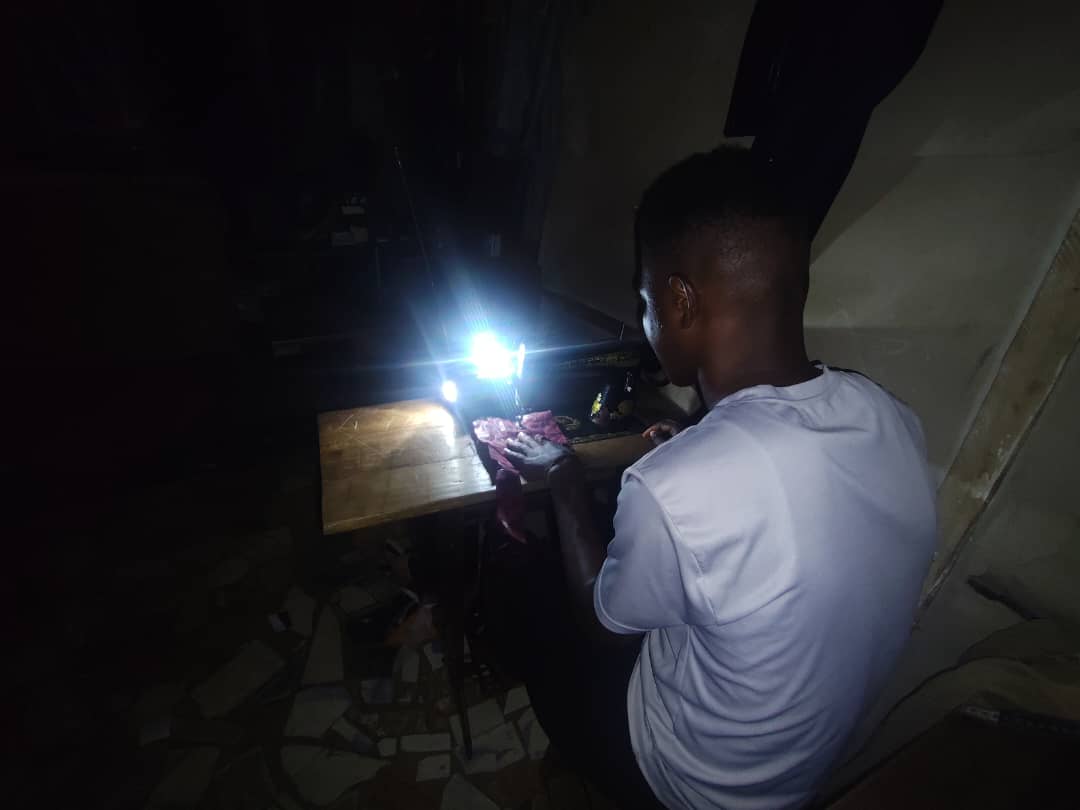
Sewing at Night
The hardest part of living without reliable electricity is not the absence of power. It's the unpredictability of it.
A household in Freetown might have stable electricity for two weeks. Then nothing for four days. Then a few hours on Thursday. Then nothing again through the weekend. There's no reliable schedule. There's no consistent window to plan around. The power comes when it comes and disappears without notice.
This unpredictability is more disruptive than a total absence would be, because a total absence forces adaptation. When you know the grid is never coming on, you build a system that doesn't depend on it. When the grid comes on sometimes, you're constantly recalibrating between dependence and independence.
The families who manage best in these conditions stop trying to predict the grid and start building daily routines that work whether the power is on or off. They treat any electricity as a bonus, not a baseline. They charge everything the moment power is available. They store energy the way they store food, as a resource to be maintained.
2. Lighting and Exterior Security
Darkness creates opportunity for theft. This is not a theoretical concern. It's a documented reality in communities without reliable electricity and one of the most consistent findings from our field research in Sierra Leone.
When the lights go out in a neighborhood, compounds without exterior lighting become easier targets. Visibility is one of the most effective deterrents available without a security system or paid security services.
Motion sensor outdoor lights are the most practical solution for exterior security during extended outages. They activate when movement is detected, draw attention to any approach, and conserve battery by only running when triggered rather than continuously through the night.
Multiple users in our Sierra Leone field research described the outdoor motion sensor light as one of the most valued products in the bundle, specifically because of what it did for their sense of security at night.
Lighting as a deterrent works best when it's positioned where people approach, not just where people live. Focus exterior lights on entry points, gates, pathways between buildings, and any access point visible from the street or road.
3. Safe Lighting Practices
Candles and kerosene lamps are the default backup for most households without electricity. They're also the most dangerous daily lighting solution available and one of the most important things to replace.
Open flames in a home where people are moving in the dark, particularly children and elderly family members, create fire risk every night they're used. A candle left unattended while someone falls asleep, a kerosene lamp knocked over during nighttime navigation — these are not rare events. They're predictable outcomes of using open flames as routine household lighting.
Kerosene lamps add a second hazard. They produce carbon monoxide and particulate matter in enclosed spaces. Prolonged exposure causes respiratory illness. The health cost of kerosene lighting is real, ongoing, and largely invisible until it becomes a serious medical issue.
Rechargeable LED lighting eliminates both risks entirely. No flame. No fumes. No heat output that creates burn or fire risk. A rechargeable light left on through the night while a family sleeps is safe in a way that no candle ever is.
The Transition That Matters Most
Switching from candles and kerosene to rechargeable lighting is one of the highest-impact safety improvements a household can make.
It doesn't require a large investment or a complex system. It requires one reliable rechargeable light and the habit of keeping it charged.

Built for Off-Grid Daily Use
Wireless Rechargeable Light + Portable Solar Panel
The Light Providers wireless rechargeable lights, portable solar panels, and motion sensor exterior lights are built for the conditions described in this guide. Field tested in Sierra Leone. Designed for daily use without grid dependence. No installation required. No fuel. No fumes.
4. Charging and Power Management
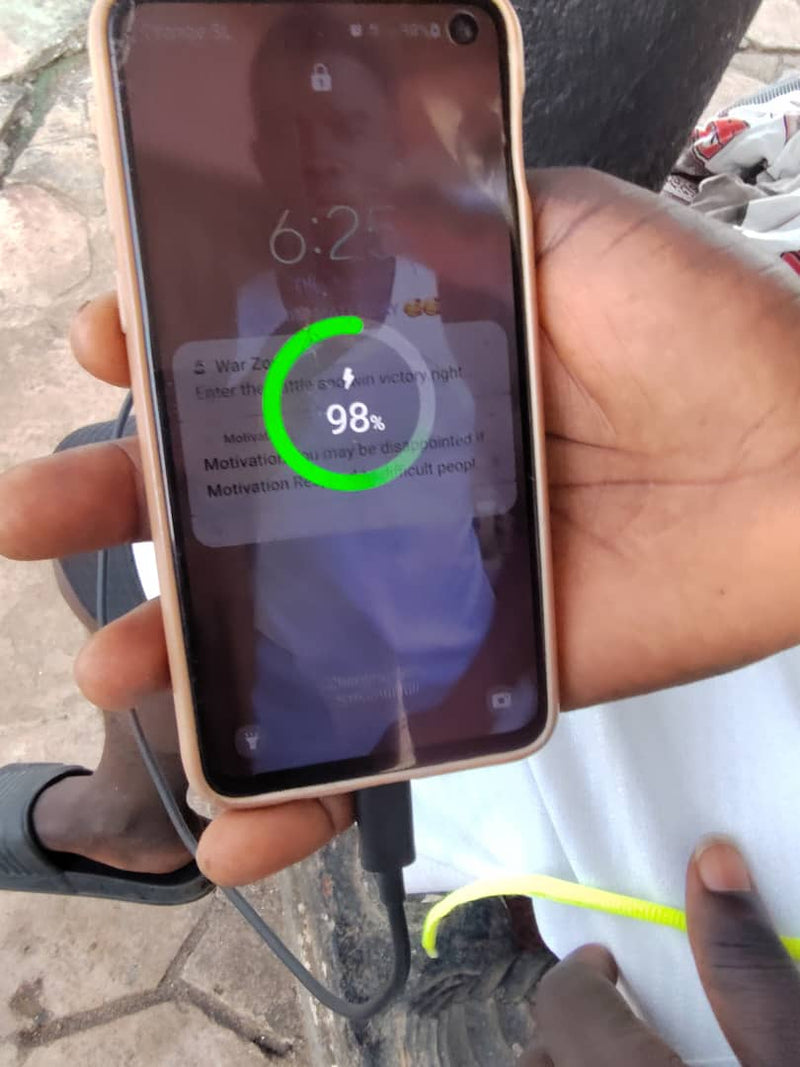
The rule for charging in a household with unreliable electricity is simple. Charge everything whenever power is available, not when devices are low.
Waiting until a phone is at 10 percent before charging is a reasonable habit when the outlet is always there. In a home where electricity might disappear for three days, a phone at 10 percent when the power cuts is effectively a dead phone.
Charge as soon as the power comes on. Charge to full before you do anything else. Keep lights, power banks, and essential devices charged to 100 percent at all times during any period when electricity is available.
Prioritize in this order. Communication devices first. A charged phone is your connection to family, emergency services, and information. Wireless lights second, so the household has illumination that night regardless of what the grid does. Power banks third, as a buffer for the gap between charging windows.
Disconnect electronics when the power is unstable. Voltage surges when electricity returns after an outage are a documented cause of device damage in regions with unstable grids. When power comes back on after an extended outage, unplug sensitive electronics and plug back in carefully once power has stabilized.
5. Solar, Batteries, and Power Systems
Solar power is one of the most practical solutions available for households living with unreliable electricity. West Africa and the Caribbean are among the highest-solar-irradiance regions in the world. The sun that creates the heat also creates the power, and it's more reliable than any grid.
Solar panels generate electricity during daylight. Without battery storage, that electricity isn't available at night. A solar panel on a rooftop or in a window charges a battery during the day. If there's no battery, there's no stored power for evening use. This is why a solar panel without a battery storage component is an incomplete solution for households that need light after dark.
For portable solar panels like the ones we design at The Light Providers, the charging target is the wireless light itself and connected devices. The panel charges the light's built-in battery during daylight hours. That battery then powers the light through the evening. The cycle is self-contained and requires no additional battery storage system.
Load-shedding schedules, where they're published by local utilities, can help with planning. If the grid is reliably on from 8 AM to 2 PM and off the rest of the day, that window is your charging priority. When the schedule is unpredictable, the portable solar panel becomes more important because it creates a charging window independent of the grid entirely.
6. Generators and the Real Cost
Generators feel like the complete backup power solution. In practice, they're one of the most expensive and demanding ways to manage electricity insecurity long term.
Fuel costs accumulate fast. A small household generator running several hours per day consumes fuel that must be purchased regularly, transported, and stored. In Nigeria, households with generators spend the equivalent of hundreds of dollars annually on fuel alone, before accounting for maintenance or the generator's purchase cost.
Maintenance adds another layer of ongoing expense. Generators require regular oil changes, air filter replacements, and periodic professional servicing to remain reliable. A generator that isn't maintained will fail, usually at the least convenient moment.
For lighting and device charging, a portable solar system with rechargeable lights is less expensive over time, requires no fuel, produces no fumes, and works silently without maintenance. The calculation is worth making honestly. For the specific tasks of keeping lights on and phones charged, solar wins on cost, convenience, and reliability over any extended period.
7. Food and Refrigeration Without Power
Keep the refrigerator and freezer doors closed from the moment you know the power is going to be out for an extended period. A refrigerator with the door kept closed maintains safe temperatures for roughly four hours. A full freezer can hold safe temperatures for 24 to 48 hours. Every time the door opens, cold escapes and that window shortens.
Store ice and ice packs in the freezer as a standard part of household management, not just during anticipated outages. Ice packs melt more slowly than loose ice, don't create water, and can be refrozen when power returns.
Eat perishable foods first. Plan meals around power availability. When electricity is on, use it to cook larger quantities that can be eaten over the next day or two without refrigeration. Dry goods, canned foods, and foods that don't require cooking or cold storage should be stocked as a baseline.
8. Ventilation and Comfort
Without air conditioning or electric fans, interior temperatures in West Africa and the Caribbean can become genuinely uncomfortable and in extreme heat conditions a health concern.
Open windows for airflow as the primary ventilation strategy. Cross-ventilation, meaning windows open on opposite sides of a room or building, creates air movement even without any powered assistance.
Window screens or nets serve two functions. They allow ventilation while keeping insects out, which matters especially in regions where mosquitoes are vectors for malaria and other diseases.
For households supporting family abroad, portable battery-powered fans are worth including in a care package or shipping alongside lighting products. A small USB-powered fan running from a charged power bank can make the difference between a comfortable night's sleep and an exhausting one in a hot room without airflow.
9. Daily Routine and Preparedness
The households that manage unreliable electricity most effectively are the ones that have built routines around it rather than continuing to plan as if reliable power is the baseline.
This means charging everything during every window of available electricity, not just when devices are low. It means completing power-dependent tasks, cooking larger quantities of food, running appliances, charging all devices, during whatever reliable window exists rather than spreading tasks throughout the day and hoping power stays on.
It means having lights mounted and ready before dark rather than looking for them when the grid cuts at 7 PM. It means keeping the wireless light charged as consistently as you keep your phone charged, because during an outage they serve equivalent functions.
Consistency in these habits is what separates households that manage well during extended outages from those that feel constantly disrupted. The outage itself doesn't change. The readiness for it does.
10. Property and Personal Security
Security during extended outages requires a layered approach because darkness removes the passive security that visibility provides during daylight hours.
Bring valuable items inside before dark during extended outages. Tools, equipment, vehicles, and anything stored in accessible outdoor locations are more vulnerable at night than during the day. Making this a consistent evening habit rather than a response to a specific threat reduces the risk without requiring active monitoring.
Use locks consistently. Exterior doors, compound gates, storage areas, and any valuables that can be secured should be locked as a default during outages, not as a special measure.
Position exterior motion sensor lights where they cover the areas of greatest access risk. A light that activates when someone approaches the gate or enters the compound provides a signal to the household and a deterrent to anyone considering approaching without invitation.
11. Common Mistakes to Avoid
- Relying on candles for daily lighting. Candles are a fire hazard and a health risk as regular lighting. A rechargeable LED light is safer, brighter, and more reliable for everyday household use.
- Not charging when power is available. Waiting until devices are low before charging in an environment with unreliable electricity means regularly running out of power at the worst possible moments. Charge at every opportunity, to full, regardless of current battery level.
- Assuming power will return quickly. In communities with chronic electricity instability, extended outages of 24 hours or more are common. Plan for the outage to last longer than you expect it to.
- Leaving valuable items outside overnight. The habit of securing belongings before dark is more reliable than trying to remember during a specific outage.
- Using solar panels without understanding the storage limitation. A solar panel without battery storage provides power only while the sun is shining. Planning to use solar power at night requires a battery component.
- Neglecting exterior lighting. Interior lighting keeps people safe inside the home. Exterior lighting keeps the property itself visible and deters approach. Both matter and neither substitutes for the other.
Living Without Electricity Requires a System, Not Just Supplies
The families who live well without reliable electricity haven't found a way to make the grid reliable. They've built a system that makes the grid optional.
That system has consistent habits at its core. Charge when power is available. Use rechargeable lights instead of candles. Secure the property before dark. Plan meals around power windows. Keep exterior motion sensor lights positioned where they provide coverage. Maintain the portable solar panel as the backup charging source that doesn't depend on the grid at all.
The system doesn't have to be expensive or complicated. A wireless rechargeable light, a portable solar panel, a motion-sensor exterior light, and the habits to use them well give a household more stability than a generator, without the recurring fuel costs, maintenance burden, or safety risks.
That's what this guide is built on. Not theory. What families in Sierra Leone, Nigeria, Ghana, Haiti, and across the Caribbean actually do to live well despite the grid.
Explore Portable Solar Lighting Systems Designed for Real-World Use
The Light Providers wireless rechargeable lights, portable solar panels, and motion sensor exterior lights are built for the conditions described in this guide. Field tested in Sierra Leone. Designed for daily use without grid dependence. No installation required. No fuel. No fumes.