

Bring Light to the Communities You Serve.
Portable solar lighting is the one thing you can bring on a mission trip that keeps serving the community long after your team flies home. No fuel. No grid. No ongoing cost.
Mission Alignment
The Impact That Lasts After You Leave
Most supplies brought on mission trips fall into one of two categories: perishable or temporary. Food is consumed. Clothing wears out. Batteries drain and cannot be replaced. School supplies run out. These items matter in the moment — but the moment passes, and the community is left in the same underlying conditions.
Electricity is one of those underlying conditions. Communities without reliable power face the same challenges every day: no light after dark, no way to charge phones and stay connected, no ability for students to study after sunset, no lighting for small businesses trying to serve neighbors after the grid cuts out. These are not one-time problems. They are daily ones.
Bringing solar lighting into a community is fundamentally different from bringing food or supplies. It does not get used up. It does not expire. It charges from sunlight every morning and provides light every night — for years. The infrastructure you bring on one mission trip can serve a community for a decade.
Our products are field-tested in Sierra Leone — one of the most challenging electricity environments in the world. When we say a light runs up to 8 hours on high, that is a field number from the exact kind of environment your mission team will be distributing into, not a lab number.
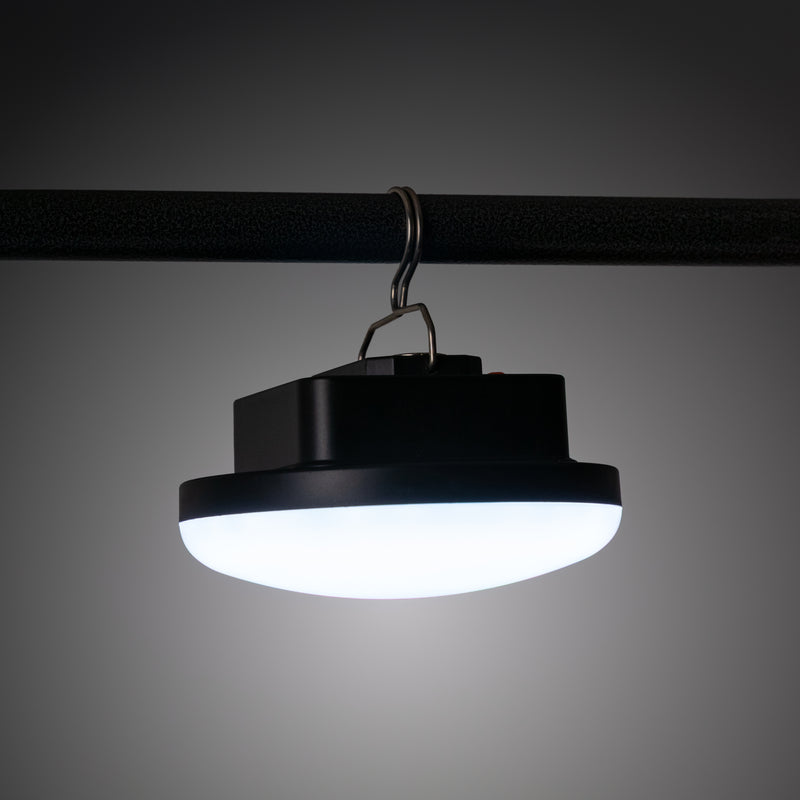
Wireless Light Hanging
The Solution: Portable Solar Lighting That Keeps Serving
A portable solar lighting system requires no infrastructure, no installation, no fuel, and no ongoing cost after the initial purchase. Your team can carry units in luggage, distribute them on arrival, and know with confidence that every household receiving one will have reliable light that evening and every evening after.
Our system includes a wireless, rechargeable LED light that runs for up to 8 hours on high, and a portable solar panel with two USB-A ports that charge the light and devices directly from sunlight. The solar panel contains no battery, so it can be packed in checked luggage without restrictions. The wireless light contains a rechargeable lithium battery and travels in carry-on bags.
No complicated setup. No technical knowledge required. If the person receiving it can charge a phone, they can use this system.
For communities living with daily blackouts — like those your team will encounter in Nigeria, Ghana, Sierra Leone, Haiti, or other regions with unreliable electricity — this is not a nice-to-have. It is infrastructure that changes the texture of daily life immediately and sustains that change long after your team has returned home.
What Makes The Light Providers Different
We Test Where It Matters
Our products are tested in Sierra Leone. It's one of the most challenging electricity environments in the world. We verify runtime, solar charging performance, and durability in real households, real communities, and real conditions where blackouts are daily, and the stakes are genuine. When we say a light runs up to 8 hours on high, that is not a lab number. It is a field number from the exact kind of environment your mission team will be entering.
That matters when you are handing a product to a family in rural Nigeria or a community in Haiti and telling them they can depend on it. We do not make claims we have not validated in the field.
Our Products Come With Usage Guidance
Every Light Providers product includes a warning and usage guide to ensure it is used correctly and safely. Proper placement of the solar panel, correct charging habits, and safe handling of the rechargeable light all affect performance and longevity. We include this guidance not to complicate the product, but to protect the people using it and to ensure every household gets the full value of what your team delivered.
When you distribute our products on a mission trip, you aren't just handing over a light. You're handing over a system with instructions designed to help the recipient use it correctly from day one.
Built for the Communities You Serve
Most solar lighting products are designed for consumers who have other options. Our products are designed for people who do not. That design philosophy shows up in every decision we make, from the materials we choose to the brightness settings we prioritize to the way we write our usage instructions. The communities your organization serves are not an afterthought in our product development. They are the starting point.
Where Organizations Use Our Products
Whether your team serves abroad or supports communities at home, portable solar lighting integrates directly into your mission.
Churches on International Mission Trips
Your team is already packing supplies to bring abroad. Adding portable solar lights to your mission kit means every family you visit has something that works for them the night you leave and every night after. Particularly impactful for teams serving in West Africa, the Caribbean, Central America, and Southeast Asia, where electricity access is limited or unreliable. For more on the daily reality your team will encounter, see our Daily Blackouts page.
Faith-Based Organizations Supporting Families Abroad
Many diaspora members of your congregation are already supporting their families in countries with unreliable electricity. A group purchase through your church gives those families something that money transfers cannot always provide: durable infrastructure that reduces daily burden and increases safety. See how this connects to our Send Light page.
Nonprofits and Community Development
Whether your nonprofit operates in the field or coordinates support from the United States, portable solar lighting integrates easily into existing community programs. Schools, health clinics, community centers, and individual households all benefit from reliable lighting that requires no grid access and no ongoing maintenance budget.
Disaster Relief Organizations
In the aftermath of hurricanes, floods, and infrastructure failures, reliable lighting is a critical need. Our portable solar systems can be deployed immediately, require no installation, and operate independently of damaged grid infrastructure. Units can be distributed individually to households or used collectively in relief centers and staging areas.
Bulk and Group Orders Welcome
Whether your team is equipping 10 families or 100, we can support your organization's order. Contact us to discuss quantities, logistics, and coordination of distribution across your team's checked luggage for international trips.