Skip to content

Travel to Areas with Unreliable Electricity

Built for Real Travel Situations

This isn't gear for just extreme expeditions. It's the gear for the real, everyday situations that diaspora travelers and international visitors face:

  • Visiting family in a neighborhood where the power cuts every evening at 7 PM
  • Traveling between cities and spending nights in towns with no grid access
  • Staying in guesthouses or family homes without backup generators
  • Moving through rural areas where electricity is absent, not just unreliable
  • Experiencing unexpected outages in urban hotels during storm season
  • Being the person everyone in the household turns to when their phone needs charging

The reality is simple: it's better to have it and not need it than to need it and not have it.

Where This Matters Most

Power outages are not a travel inconvenience in these places. They are a daily reality. If your trip takes you to any of the following countries, reliable portable lighting is not optional.

  1. Sierra Leone: Among the lowest electricity access rates in the world. Most households outside Freetown receive little to no grid power. Outages in urban areas are long and frequent.
  2. Liberia: Grid infrastructure is severely limited. Large portions of the population have no access to electricity at all. Generators and solar are the primary sources of power for most families.
  3. Nigeria: In parts of Nigeria, daily outages of 8 to 20 hours are common nationwide. The national grid, known locally as NEPA, is widely unreliable. Generator fuel costs are a significant household expense.
  4. Haiti: The national grid has largely collapsed in many areas. Most households depend on generators or go without power entirely. Rural regions can go days without access to electricity.
  5. The Democratic Republic of Congo: One of the largest countries in Africa, with one of the lowest electricity access rates. Outside of major cities, reliable power is essentially nonexistent.
  6. Chad: Electricity access is limited to a small percentage of the population. Outages are unpredictable and prolonged, even in areas with some grid connection.
  7. Ghana: Known locally as dumsor. In parts of Ghana, load shedding cycles can cut power for 8 to 12 hours per day. Rural and peri-urban areas are significantly more affected.
  8. Cuba: Rolling blackouts lasting 8 to 20 hours have become routine. Infrastructure challenges have made reliable electricity increasingly difficult across the island.
  9. Puerto Rico: Hurricane damage and ongoing infrastructure vulnerability mean periodic outages are a recurring reality, particularly in rural and mountainous areas. Many communities remain underserved by the grid.
  10. Jamaica: Periodic outages worsen during hurricane season and heat peaks. Rural parishes experience more frequent and extended power cuts than urban centers.

The Problem With Traveling Without Reliable Power

Most travelers assume a power bank is enough. It is not.

Standard power banks have no way to recharge themselves once they are drained. The small built-in solar panels on many budget power banks are largely ineffective because they are too small to generate a meaningful charge. They cannot fully recharge a fully drained cell phone battery via solar in any reasonable amount of time.

So when your power bank runs out during a long blackout, you are left with no light, no charged phone, and no way to stay connected or call for help.

Even travelers staying in hotels face this. You will spend time outside the hotel. You will visit family in neighborhoods where the grid has been out for hours. You will travel between cities on unlit roads. You will be in situations where the outlet in your room cannot save you, because you aren't in your room.

The real challenge begins the moment you step outside.

A Better Solution: Portable Solar Lighting Systems

Instead of depending on a single power bank, build a system.

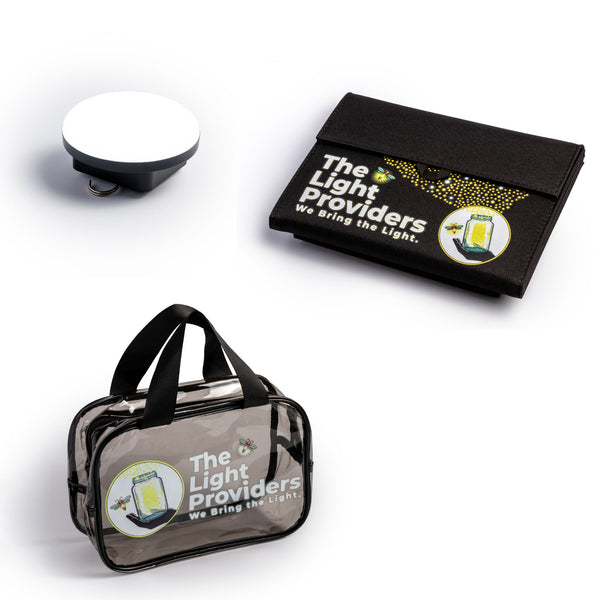
A portable solar lighting setup includes two components that work together: a wireless rechargeable LED light that provides up to 8 hours of reliable illumination on high, and a portable solar panel that charges your light and your devices directly using sunlight during the day.

Our portable solar panel contains no battery. It works by converting sunlight directly into power and delivering that charge to whatever is connected through its two USB-A ports. When the sun is shining, the panel is charging. When you disconnect, the power stops. There is no stored energy, no battery management, and no fire risk. This also means it can be packed in your checked luggage without restriction.

The wireless light contains a built-in rechargeable battery and must be packed in your carry-on bag in accordance with standard airline lithium battery policies.

Together, these two items create a self-sustaining daily cycle. The sun charges the panel. The panel charges the light and your devices. The light runs through the night. You wake up, put the panel back in the sun, and the cycle starts again — no outlet required.

What Your Travel Lighting Kit Should Include and Where it Should Go

Getting through the airport with your lighting kit is straightforward when you know the rules.

1. Portable Solar Panel (Checked Bag)

A portable foldable solar panel with two USB-A ports that charges your light and your devices directly from sunlight with no battery, no installation, and no fuel.

Our solar panel contains no battery. It charges devices directly from sunlight through two USB-A ports. Because there is no lithium battery inside, it is not subject to airline carry-on battery restrictions and can be packed safely in your checked luggage.

2. Wireless Rechargeable Light (Carry-On Only)

A wireless rechargeable LED light that runs up to 8 hours on high and provides room-level illumination, not just a flashlight beam. 

The wireless light contains a built-in rechargeable lithium battery. In line with standard airline regulations for lithium batteries, it must travel in your carry-on bag. Do not pack it in checked luggage.

3. Power Bank (Carry-On Only)

A high-capacity power bank of at least 10,000 mAh is an additional charging buffer for phones, tablets, and other devices. Power banks contain built-in rechargeable batteries. In line with standard airline regulations for lithium batteries, it must travel in your carry-on bag. Do not pack it in checked luggage.

4. Charging Cables (Either)

What most people forget and what causes the most frustration once they arrive is the cables. Cables are the connective tissue of your entire travel power setup. Without the right ones, nothing works together the way it should. Your solar panel cannot charge your light. Your power bank cannot charge your phone. Your adapter is plugged into the wall, and your device is sitting next to it, uncharged, because you brought the wrong cable or left the right one at home.

What Cables to Pack
  • USB-A to USB-C: The most essential cable for most modern travelers. Our portable solar panel outputs through two USB-A ports. If your wireless light, phone, or any other device charges via USB-C, this cable connects your solar panel to everything it powers. Pack at least two.
  • USB-A to Micro-USB: Older devices, some wireless lights, and certain accessories still charge via Micro-USB. If any device in your kit uses this connector, pack at least one cable. It takes up almost no space, and having it available could matter at the worst possible moment.
  • USB-C to USB-C: If you are carrying a newer laptop, tablet, or device that charges via USB-C, pack one separately. It will not connect directly to the solar panel's USB-A ports, but it pairs with a USB-C power bank or wall adapter when grid power is available.
  • USB-A to Lightning: For travelers still using Apple devices that charge via the Lightning connector, this cable connects directly to the solar panel's USB-A ports for charging phones and other devices.
How Many Cables to Pack

The general rule is one cable per connection you need to make, plus one spare for each cable type you depend on most. Cables break, get lost in bags, or get borrowed and not returned. A spare costs almost nothing to pack and eliminates a problem that would otherwise be significant.

If your kit includes a solar panel, a wireless light, and a phone, you need at a minimum:

  • One cable from the solar panel to the wireless light
  • One cable from the solar panel or power bank to your phone
  • One spare of each

That is four cables total. They weigh almost nothing and fit in any pocket of any bag.

Packing Tips for Travel Cables

Keep all cables together in one small pouch or organizer. Searching through a bag for a cable in a dark room during a power outage is exactly as frustrating as it sounds. That's why our Clear Utility Travel Bag not only fits two wireless lights and a solar panel, but also lets you see all your cables. 

5. Universal Travel Adapter (Either)

A universal travel adapter with surge protection to guard your devices against voltage spikes when grid power is unstable.

A universal adapter with surge protection has no battery and can go in either bag. Surge protection matters in countries with unstable voltage. Spikes in power when it returns after an outage are a common cause of device damage.

Together, these five items cover every scenario: planned outages, unexpected blackouts, remote travel, and anything in between.

Leave It Behind as a Gift

Here is something most travel guides will not tell you.

The lighting kit you pack for your trip doesn't have to come home with you. When you leave a wireless rechargeable light and solar panel with family, you leave behind something that keeps working long after your flight lands. The panel sits in the sun each day and charges through its two USB-A ports. The light runs through the night. The phones stay charged. The generator bills drop.

You brought it for your trip. Leave it as infrastructure. That is the gift that keeps returning.

Travel Lighting Frequently Asked Questions

Can I pack the solar panel in my checked luggage?

Yes. Our portable solar panel contains no battery. It charges devices directly from sunlight via two USB-A ports and stores no energy. Because it does not contain a lithium battery, it is not subject to airline carry-on battery restrictions and can be packed in your checked bag without issue.

Can I pack the wireless light in my checked luggage?

No. The wireless light contains a built-in rechargeable lithium battery and must be packed in your carry-on bag. This is a standard airline regulation that applies to all devices with lithium batteries. Do not pack it in checked luggage.

How does the solar panel charge devices if it has no battery?

The panel converts sunlight directly into electrical current and delivers that charge through two USB-A ports to whatever is connected. When the sun hits the panel, connected devices charge. When you disconnect the panel or move it out of sunlight, charging stops. There is no stored energy in the panel itself.

Can I charge two devices at the same time?

Yes. Our portable solar panel has two USB-A ports, so you can charge two devices simultaneously. Charging speed may be reduced when both ports are in use, depending on available sunlight.

Will the solar panel work in countries like Nigeria, Ghana, or Haiti?

Exceptionally well. West Africa and the Caribbean have some of the highest solar irradiance in the world. These regions receive consistent, strong sunlight that is ideal for direct solar charging. The same geography that creates the heat also creates the power.

How long does the wireless light run on a full charge?

Up to 8 hours on high. Lower brightness settings will extend the runtime beyond that. Our specs are based on field testing under real-world conditions, not in lab environments.

What if I am staying in a hotel with electricity? Do I still need this?

Hotel power is not guaranteed to stay on, and most of your meaningful time during a diaspora visit will be spent outside the hotel with family. Having your own lighting and charging system means you are never a burden to your hosts and never caught unprepared when the grid cuts out.

Can I leave the kit with family when I return home?

That is exactly what many of our customers do. The Light + Solar Bundle is designed to be left behind as practical, lasting infrastructure. Your family benefits from it every night after you leave.

Compare products

{"one"=>"Select 2 or 3 items to compare", "other"=>"{{ count }} of 3 items selected"}

Select first item to compare

Select second item to compare

Select third item to compare

Compare